What does it mean to slow down? — In a culture defined by speed, the question can sound almost like a contradiction. We are encouraged to respond faster, decide faster, travel faster and complete more in less time. Deadlines are not simply met; they are chased. Efficiency has become one of the dominant measures through which we evaluate not only our work, but increasingly our lives.
We rarely ask whether everything that can be accelerated should be. Speed is often associated with progress. Slowing down, by contrast, can appear passive, unproductive or even irresponsible. Yet there are experiences, decisions and ideas that cannot be compressed without losing something essential. Sometimes, moving more slowly is not a rejection of progress. It is the condition that makes meaningful progress possible.
A Design Studio Called ‘Slow Down’
I first began thinking seriously about this question while studying architecture. — One of our design studios, led by Professor William Alsop, carried a remarkably simple title:
Slow Down.
At the time, the title felt almost contrary to everything a young architecture student wanted to achieve. — Who wants to slow down as a student? We wanted to move forward. We wanted to learn faster, develop more ideas, produce more drawings and arrive at convincing architectural proposals as quickly as possible. But that apparent contradiction was precisely the point of the studio.
We were encouraged by Professor Will to consider the speed of contemporary life and the ways in which constant activity can gradually separate us from one another and, perhaps more importantly, from ourselves.
The task was not simply to design a quiet room. We were asked to imagine a space, a building or a spatial framework in which an individual could genuinely slow down. The question was therefore not only architectural. It was also deeply personal:
Can space create the conditions in which we become aware of ourselves again?
Crossing the Water
My own proposal began with a waterfall positioned in the middle of the city. — It was not intended merely as an object to be observed from a distance. It was conceived as a threshold that a person could choose to cross.
On a hot summer day, one could walk directly through the falling water. Behind it, almost concealed from the city, there would be a translucent and protected space. The city would remain present. People would continue moving nearby. Traffic, conversations and everyday urban life would not disappear. Yet the sound of the waterfall would transform all those separate noises into one continuous field.
The water would create a form of white noise. It would not produce silence by removing sound. Instead, it would make the surrounding world less demanding. Individual distractions would begin to dissolve into the background.
For a moment, one could remain physically close to everyone while being psychologically returned to oneself. The act of walking through the water was important. It created a transition.
One would enter carrying the rhythm of the city and emerge into a different relationship with that same environment. The water would refresh the body, but it would also establish a perceptual boundary between the continuous activity outside and the protected moment within. Nothing in the city would need to stop. Only the individual’s relationship to it would change.
Small Changes in Position
As part of the studio, we also developed a collective intervention in a park. We placed a series of platforms at different positions, levels and orientations. Each one offered a slightly different way of occupying and observing the surrounding space. The interventions were relatively simple, but that simplicity became part of their value.
A platform does not necessarily create a room. It does not require walls, doors or a roof. Yet by slightly lifting, lowering or redirecting the body, it can alter the way a person experiences an otherwise familiar place. A small physical shift can produce a significant perceptual shift.
This idea became even clearer in one project presented by a fellow student. — Her proposal has remained with me for many years. — She described feeling an unusual sense of calm in extremely busy places. One of the environments she mentioned was Vienna’s main railway station: a place of constant arrivals and departures, announcements, footsteps, conversations and people moving in different directions.
It hardly represents the conventional image of peace. Instead of trying to remove the individual from that activity, however, she changed the position from which it was experienced. She imagined a place in which one would sit extraordinarily low—almost directly on the ground.
Everybody else would continue moving at the usual level and speed. The station would remain busy. Trains would continue arriving. People would continue running, waiting and searching for their platforms.
But from this lower position, one would no longer participate in the movement in the same way. One would observe it. The nervous activity of the station could gradually become a visual and acoustic background—another form of white noise, not entirely different from the sound of my waterfall.
I found that idea remarkable. — It suggested that slowing down does not necessarily require a quieter world. Sometimes it requires a different position within the world that already exists.
When Movement Becomes Background
We often imagine that calm can only be found by escaping. We wait for the workload to decrease. And we wait for the city to become quieter. And we wait for the telephone to stop ringing, for the next holiday to begin or for a future moment in which fewer things will require our attention. But that moment may never arrive on its own.
There will always be another message, another task, another deadline, another piece of information and another possibility asking us to react.
The issue is not necessarily that any of these things is bad. The difficulty lies in their continuity. There is increasingly little space between one stimulus and the next. We become highly practised at reacting, but perhaps less practised at noticing. And yet it is within the space between reactions that some of our most important thoughts begin.
Slowing down, in this sense, does not simply mean doing less. It means creating enough distance from continuous reaction to become capable of perception again. — To recognise what we actually think. To understand what we genuinely need. And to distinguish our own direction from the direction in which everything around us happens to be moving.
Architecture as an Organisation of Attention
The Architecture has always influenced the speed at which we experience the world. — A narrow corridor can accelerate movement. — Also a staircase changes our rhythm. — And a threshold introduces a moment of transition. — And a bench interrupts a path. — A framed view can hold our attention. — And a courtyard can separate us from a street without removing us from the city. — Water can mask surrounding noise. — A change in floor level can transform somebody from a participant in movement into an observer of it.
Architecture therefore does more than organise functions and movement. — It also organises attention. — It can encourage us to pass through a place as efficiently as possible, or it can give us a reason to remain. — It can expose us to activity, filter it or temporarily place us at a distance from it.
In a culture preoccupied with optimisation, perhaps architecture should not always be expected to make every path shorter and every process faster. Not every second saved is necessarily a second gained. Sometimes the greater value lies in creating a legitimate reason to pause.
Slowing Down Is Not Passivity
There is an important distinction between slowing down and withdrawing from life. For me, slowing down does not mean abandoning ambition or responsibility.
I run an architecture office. Deadlines are real. Projects need decisions. People depend on one another, and our work has consequences. There are moments in which speed is necessary and efficiency is valuable. The question is not whether we should move quickly. The question is whether we still recognise when speed serves us—and when we have begun serving speed.
There are decisions that improve when they are made quickly. There are others that become superficial. And there are ideas that need immediate action. And there are others that require time before they reveal what they could become.
Design belongs strongly to the second category. A project cannot be meaningfully developed if every uncertain moment is understood merely as a delay. Architecture needs intervals in which we can observe, question, test and reconsider.
Relationships require something similar. — Perhaps life itself does as well. — Slowing down is therefore not an absence of movement. — It is the recovery of attention.
Finding a Different Level
I still return to the image of my colleague sitting almost on the floor while an entire railway station continued moving around her. Nothing around her had to change. The people did not need to stop. The station did not need to become silent. The trains did not need to suspend their journeys. Only her position changed.
Perhaps that is why the proposal remained so memorable to me. It challenged the idea that a different internal experience always requires a completely different external world.
Sometimes we do not need to escape. Sometimes we only need to shift our position. — To sit a little lower. — To stand a little higher. — To move behind the sound of falling water. — To step onto a platform in a park. — To allow the activity around us to become background rather than instruction.
The space in which we reconnect with ourselves does not necessarily have to be completely isolated or silent. It only needs to give our own thoughts enough room to become audible again.
When Did We Last Slow Down?
I find myself returning to the same question that began that design studio many years ago:
When did I last genuinely slow down?
Not simply stop working. — Not merely sit down while continuing to move through tasks, messages and thoughts. — But slow down enough to become fully present within one moment.
When did I last change my position — physically or mentally — and observe the world without immediately feeling required to react to it? When did I last create a small amount of space that belonged only to my own thoughts?
Perhaps slowing down does not begin with discovering a quieter world. — Perhaps it begins with changing our relationship to the world we already inhabit. And if it has been a long time since we experienced such a moment, perhaps that already tells us something.
Sometimes we do not need another destination. — Sometimes we simply need to find a different position in the place where we already are. — And slow down.
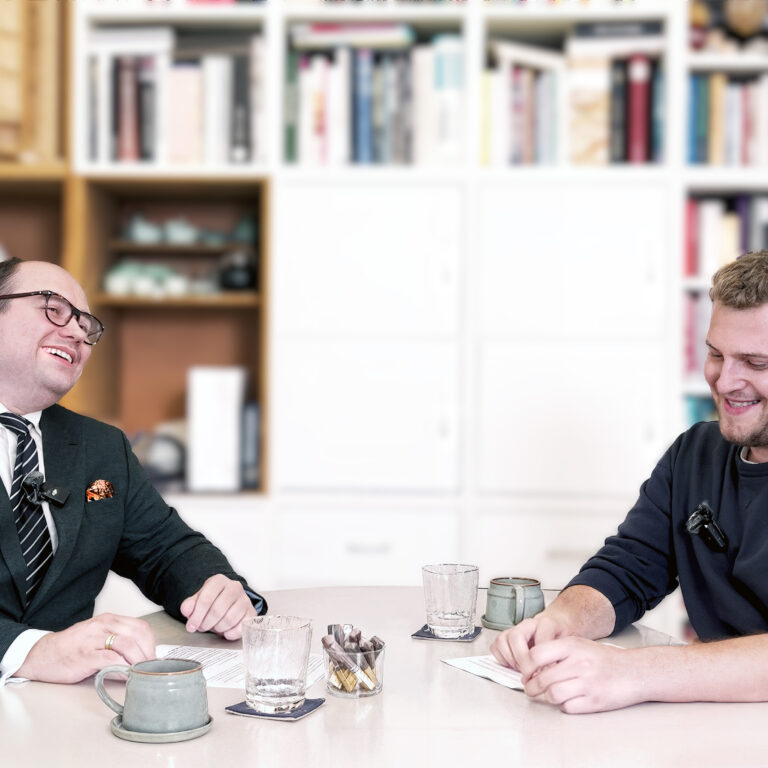
This essay developed from Episode 005 on @roberttom1c’s Instagram account of “ON THE WAY,” reflecting on a design studio led by Professor Will Alsop and on architecture’s ability to influence not only how we move, but also how we pay attention.